Background
It is widely recognised since the 1990s that the role of ICT on productivity and living standards is critical. The single largest obstacle to harnessing the power of ICT is a shortage of e-skills, particularly ICT practitioners. By 2020, Europe might face a shortage of up to 900,000 ICT professionals in Europe, while 26 million Europeans are currently unemployed. Moreover, while demand for ICT practitioners is growing by around 3% a year, the number of fresh ICT graduates and skilled ICT workers is not keeping up.
To address this problem, on March 2013 the European Commission launched a Grand Coalition for Digital Jobs1, a multi-stakeholder partnership aimed to tackle the lack of ICT skills and address the mismatch between demand for and supply of ICT-related positions across Europe.
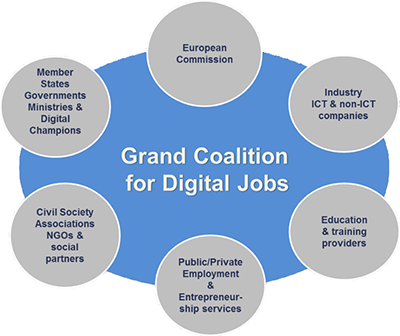
The Grand Coalition encourages stakeholders to “pledge” concrete actions, form or join national and local initiatives. So far, more than 50 pledging organisations2 have joined. Moreover, 10 national and local initiatives3 have already been launched. National and local initiatives are local multi-stakeholder partnerships which respond to the Grand Coalition goals and expectations. Their role is to promotion and implement Grand Coalition pledges at local level, awareness raising, and sprout connections between existing initiatives and the Grand Coalition.
The Secretariat of the Grand Coalition
In order to support the roll-out of the Grand Coalition the European Commission established the Secretariat of the Grand Coalition.
The Secretariat will bring together stakeholders from the demand and supply side committed to bridging the skills gaps focusing on a five-pronged strategy namely:
- ICT Training: promoting Europe-wide student placement programmes with ICT employers and working with existing ICT training providers to improve their offering to students;Mobility: helping get trained people in one part of Europe placed into vacant jobs elsewhere in the EU;
- Certification: strengthening ICT professionalism and foster recognition of ICT-related qualifications across EU member states;
- Awareness raising: raising awareness of the Grand Coalition for Digital jobs and attracting people to ICT jobs through a dedicated e-Skills for Jobs 2014 campaign;
- New forms of ICT education: promoting the supply side for ICT jobs creation through more aligned educational schemes (e.g. MOOCS, closer links between education and careers) and stimulating structural change in educational systems.
Value proposition for education and training providers
The Grand Coalition supports initiatives that encourage students to consider ICT as a career option by working directly with training and education providers (including primary and secondary schools and university) and supporting innovative ICT teaching and learning. By promoting the relevance of computer science, the Grand Coalition supports efforts that encourage more students to study ICT, with a particular emphasis on women and girls.
In this regard specific initiatives of the Secretariat of the Grand Coalition include:
- Increasing computer science support for schools;
- Making free and open training and resources available for teachers;
- Implementing the Student Placement Programme (SPP) which will create temporary job placements for students in Industry;
- Identifying new models of training;
- Promoting certification support tools and services
Getting involved
- There are many ways training and education providers can get involved, here are just a few of them:
- Get in touch with the Secretariat to find out more about the Grand Coalition and its related initiatives;
- Embrace technology in teaching and learning;
- Promote coding in schools;
- Identify what industry can do for you and tell them. The Secretariat will help you to get in touch with industry;
- Spread the word. Get more teachers involved in the initiatives of the Grand Coalitions.
Moreover, as part of the promoting coding in schools workstream, European Schoolnet and Microsoft are jointly leading discussions with the European Commission on an EU Code initiative. The scope of this initiative is to develop and deploy a large scale, long term network and campaign to promote coding in the EU by building on the code.org model. Vice President Neelie Kroes will show her support of this initiative by engaging with coding organisations and industry on 25 June 2014 during the Coding Workshop organised by DG Connect at European Schoolnet.
You can get engaged in the Grand Coalition for Digital Jobs, either by getting involved in the National/ Local Coalition in your country or by contacting the Secretariat of the Grand Coalition for support and information.
To get in touch with the Secretariat, please contact: christel.vacelet@eun.org or charmaine.kerr@eun.org